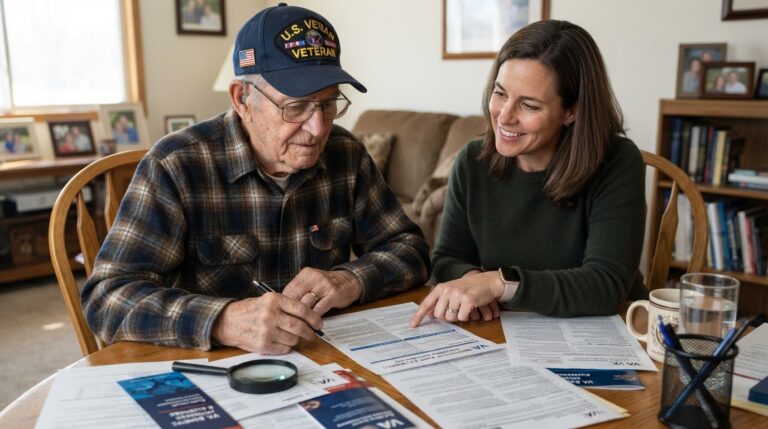
VA benefits for veterans over 65 include more than most families expect. Many start by searching for VA aid and attendance eligibility because someone needs help with daily tasks, then find that Aid and Attendance is only one piece of a larger picture.
VA offers disability compensation, pension, health care, long-term care support, and survivor benefits, and each one has its own rules. Being told no on one of them rarely answers the question for the rest. This guide covers how Aid and Attendance works and who it can apply to, along with the other questions older veterans and their families run into: who should manage a veteran’s VA payments, what DIC means for surviving spouses, and what happens to a pending claim when a veteran dies.
VA Aid and Attendance Eligibility: Four Different Paths
CThere are four main ways Aid and Attendance can come into play:
- Veterans Pension: A needs-based benefit for eligible wartime veterans who are at least 65 or meet other qualifying criteria. Veterans who need regular assistance may receive an increased pension amount, and a separate housebound allowance exists for veterans substantially confined to their immediate premises because of a permanent disability. Income and net-worth limits apply.
- Special Monthly Compensation (SMC): Additional compensation when service-connected disabilities cause a veteran to need regular aid and attendance. This path is not means-tested.
- A rated veteran’s spouse: A veteran with a qualifying service-connected disability rating of at least 30% may receive additional compensation when their spouse needs regular aid and attendance.
- Surviving spouses: An additional allowance may be available through Survivors Pension or Dependency and Indemnity Compensation (DIC), depending on eligibility for the underlying survivor benefit.
Here’s why the distinction matters: a veteran who earns too much for pension benefits could still qualify for SMC if service-connected disabilities cause the need for assistance. A denial under one set of rules doesn’t automatically close the door on the others. An accredited attorney can review the disability evidence and help identify the right compensation issue to pursue.
We’ve covered these benefits in more detail in our introduction to Special Monthly Compensation, guide to SMC levels, and overview of DIC.
What Counts as Needing Aid and Attendance
VA looks at how much help a person actually needs, not just the name of their diagnosis. Under 38 CFR § 3.351 and 38 CFR § 3.352, factors can include:
- Daily personal care: Needing help getting dressed, staying clean, eating because of weakness or poor coordination, or using the bathroom. Help with certain medical appliances or protection from everyday dangers may also count.
- Bedridden status: A condition that actually requires the person to remain in bed. Voluntary bed rest alone does not qualify.
- Nursing home care: Residence in a nursing home because of physical or mental incapacity.
- Severe visual impairment: Corrected visual acuity of 5/200 or less in both eyes, or a qualifying severe contraction of the visual field.
The person doesn’t have to meet every condition on this list, and the help doesn’t have to be needed around the clock. Medical records should show what daily life looks like: which tasks require help, why that help is needed, and how often. The paperwork varies by benefit, but forms alone don’t establish eligibility, and an SMC claim also needs medical evidence that ties the need for help to service-connected disabilities.
Pension Asset Rules and Pension Poachers
For Veterans Pension, VA also reviews income and net worth, with limits that can change each year, and it looks at assets transferred for less than fair market value during the 36 months before a claim. Under 38 CFR § 3.276, some transfers can lead to a penalty period of up to five years. These pension rules don’t apply to service-connected SMC or DIC.
That confusion is what pension poachers rely on. These companies sell older veterans and surviving spouses annuities or trusts as a shortcut to approval without explaining how those transactions could hurt eligibility. A promise of guaranteed approval, pressure to buy a product before eligibility is evaluated, or a representative who can’t show VA accreditation are all reasons to stop and ask questions. You can check credentials through VA’s accreditation search tool, and we cover the risks of unaccredited help in our article on claim sharks.
VA Fiduciaries vs. Durable Power of Attorney
When an older veteran can no longer manage money, families often turn to a durable power of attorney. VA handles this differently. A durable power of attorney is a private legal document, created under state law, that lets a person you choose make financial or legal decisions on your behalf. A VA fiduciary is someone VA itself appoints to manage a beneficiary’s VA payments.
VA appoints a fiduciary only after it determines the beneficiary can’t manage their own funds, based on medical evidence or a court finding, and any reasonable doubt is resolved in favor of competency. When VA does appoint one, it looks first to the beneficiary’s own preference if they can express one, then to a spouse, relatives, and others who are qualified and willing. VA investigates the person it chooses, including a background and credit check, and the fiduciary has to account to VA for how the money is spent. A court-appointed guardian is one of the people VA may consider.
A durable power of attorney doesn’t appear in VA’s fiduciary appointment rules, so families shouldn’t assume it will let an agent take over a veteran’s VA payments. It can still be useful for other finances and decisions. A VA power of attorney is something different again: VA Form 21-22 or 21-22a names an accredited representative to help with a claim, which is about representation, not managing money. This question comes up often with Aid and Attendance, since the same decline that creates the need for daily help can raise questions about who should manage the benefit.
Dependency and Indemnity Compensation (DIC) for Surviving Spouses
DIC is a tax-free monthly payment to eligible survivors when a veteran dies on active duty or from a service-connected illness or injury. It can also apply when a veteran dies of another cause but was rated totally disabling for a qualifying period, such as at least 10 years before death. Surviving spouses, children, and parents can qualify under different rules.
A surviving spouse generally needs to have lived with the veteran until death, or not been at fault for a separation, and to meet a marriage requirement: married for at least one year, married within 15 years of the veteran’s discharge from the period of service in which the illness or injury began or worsened, or had a child with the veteran. VA sets an income requirement for surviving parents, but its DIC page doesn’t state one for surviving spouses. That is one of the main differences from Survivors Pension, which is a needs-based benefit for surviving spouses of wartime veterans and has income and net-worth limits. DIC turns on whether the death is connected to service.
A surviving spouse who is in a nursing home or needs regular aid and attendance can receive a higher DIC amount, and remarrying at age 55 or older does not end DIC for remarriages on or after January 5, 2021 (the age was 57 before that). Survivors whose DIC claims were denied before the PACT Act may be able to reapply.
CHAMPVA, VA’s health coverage program for families, may be available to the surviving spouse of a veteran who died from a service-connected disability or who was rated permanently and totally disabled at the time of death. A surviving spouse who is eligible for Medicare must have Medicare Part A and Part B to get or keep CHAMPVA. Burial benefits include a gravesite in a national cemetery, a government headstone or marker, a burial flag, and a Presidential Memorial Certificate at no cost to the family.
What Happens to a Pending Claim When a Veteran Dies
A claim is pending when VA hasn’t made a final decision on it, whether that is an original claim, a Supplemental Claim, a Higher-Level Review, or an appeal. A veteran’s death doesn’t have to end a pending claim, but the survivor generally needs to act within one year of the date of death. Two options exist, and they work differently.
Accrued benefits are payments VA owed the veteran at the time of death but hadn’t yet paid. They go to the surviving spouse first. If there is no surviving spouse, dependent children share them, and if there are no children, financially dependent parents may receive them. VA decides an accrued benefits claim based on the evidence already in the veteran’s file at the time of death.
Substitution lets an eligible survivor take the veteran’s place and continue the pending claim or appeal. Unlike accrued benefits, the survivor can submit new evidence to support it. Which option fits depends on what is already in the file, and the one-year deadline applies to both. Surviving spouses and children generally apply using VA Form 21P-534EZ. Our article on accrued benefits and substitution explains how the two compare.
VA Disability Compensation Benefits for Veterans Over 65
Veterans can file for disability compensation at any age, and VA states that veterans and survivors can file for benefits anytime. That matters for older veterans whose service-connected conditions have gotten worse over the years, since a veteran can file for an increased rating when a condition has worsened. It also matters for conditions that were never claimed or were denied in the past.
The PACT Act expanded the list of conditions VA presumes are connected to service. For Vietnam-era veterans, high blood pressure (hypertension) and monoclonal gammopathy of undetermined significance (MGUS) were added to the Agent Orange presumptive list. VA also now presumes herbicide exposure for service at certain locations during specific dates, including bases in Thailand, Laos, Guam, American Samoa, and Johnston Atoll. A veteran whose claim was denied for a condition that is now presumptive can file a Supplemental Claim for VA to review it again.
This is also where compensation and Aid and Attendance meet. If a service-connected condition is the reason an older veteran needs daily help, Special Monthly Compensation may belong in the claim.
VA Health Care and Long-Term Care Benefits for Veterans Over 65
Apart from monthly payments, VA runs geriatric and extended care programs for veterans who need ongoing support. VA lists home-based services such as skilled home care, Home Based Primary Care, and Home Health Aide, and community-based services such as adult day health care and caregiver respite. It also lists nursing home care through VA, community, and State Veterans Homes, dementia care, and hospice and palliative care. Medical Foster Homes are described as an option for veterans who need nursing home level care in a smaller, non-institutional setting.
These are services, not cash allowances, and eligibility differs by program. VA points veterans to a VA social worker to learn which services they can use.
Caregiver Support for Families
Families who provide daily care may be able to get support of their own. VA’s caregiver programs include general services such as education, training, counseling, and respite care. The Program of Comprehensive Assistance for Family Caregivers is narrower: the veteran needs a service-connected disability rating of 70% or higher and a need for in-person personal care for at least six continuous months.
For eligible families, a primary family caregiver may receive a monthly stipend, CHAMPVA health coverage if they have no other coverage, mental health counseling, certain travel benefits, and at least 30 days of respite care per year. This program is separate from Aid and Attendance and has its own requirements.
Discuss Your VA Benefits with VA Comp Claim
Hearing “you don’t qualify” is frustrating when you or someone you love needs help. But because the right VA benefit depends on service history, disability ratings, finances, and health, one answer is rarely the end of the story.
When a veteran’s need for help or a worsening condition traces back to service, the evidence behind the claim matters. VA Comp Claim Disability Law Practice can review disability compensation claims, identify gaps in the evidence, and help with eligible appeals. Contact our team to discuss your situation and whether representation is a fit.